
S01
00Edge runtime product
A signed software path from model to device.
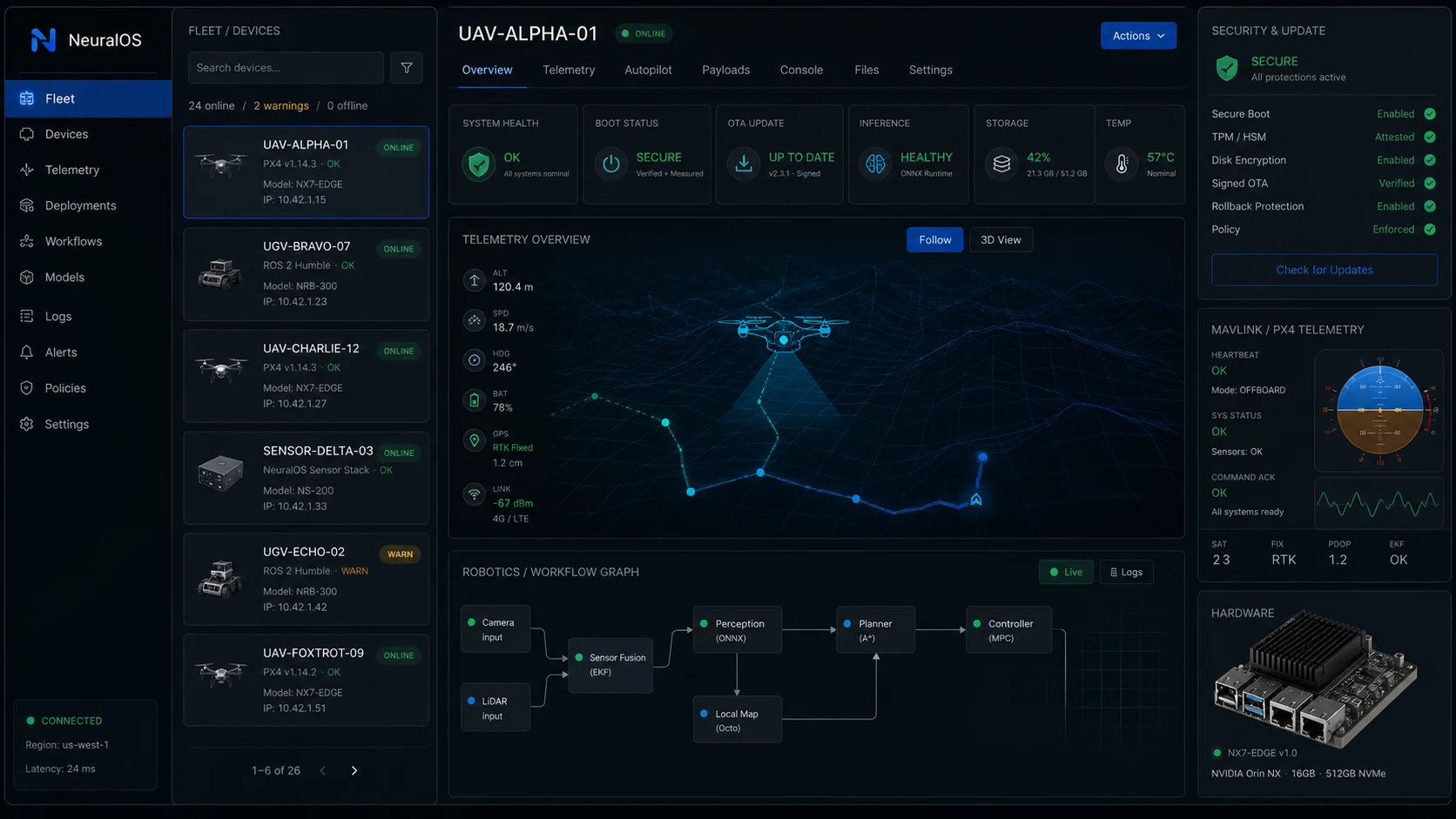
NeuralOS packages Linux 6.12 LTS, PREEMPT_RT, secure OTA, model encryption, drone protocols, robotics workflows, and 12 inference backends into one deployable edge runtime.
NeuralOS v5.0.0 · Buildroot 2025.08 · NPIE v2.0.0
- Minimum RAM
- 64 MB
- Worst-case latency
- <1 ms
- Boot time
- <5 s
- Inference backends
- 12
- Desktop apps
- 33
- Custom packages
- 46
01Operating contexts
One edge runtime for drones, uncrewed systems, and robot fleets.
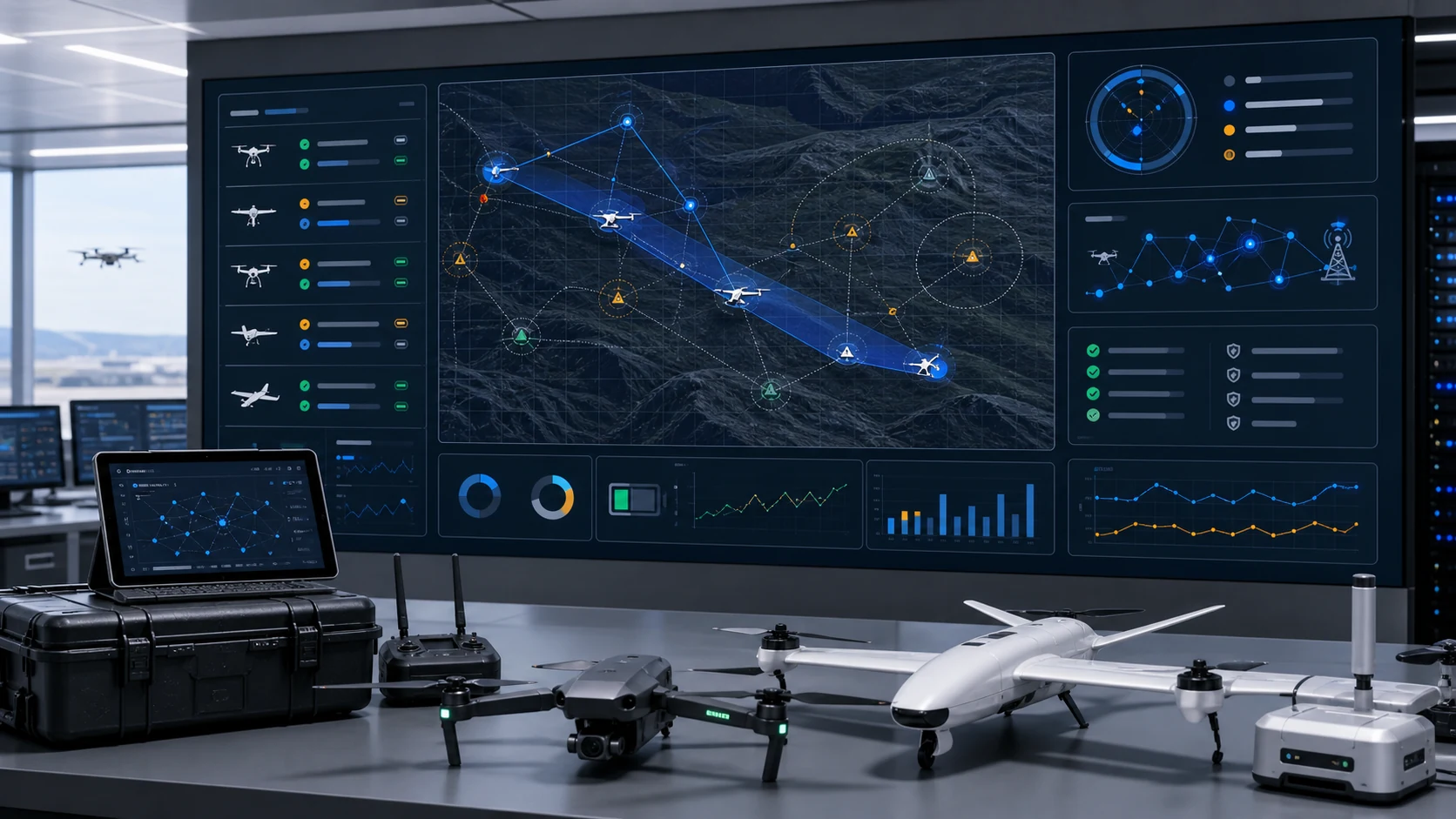
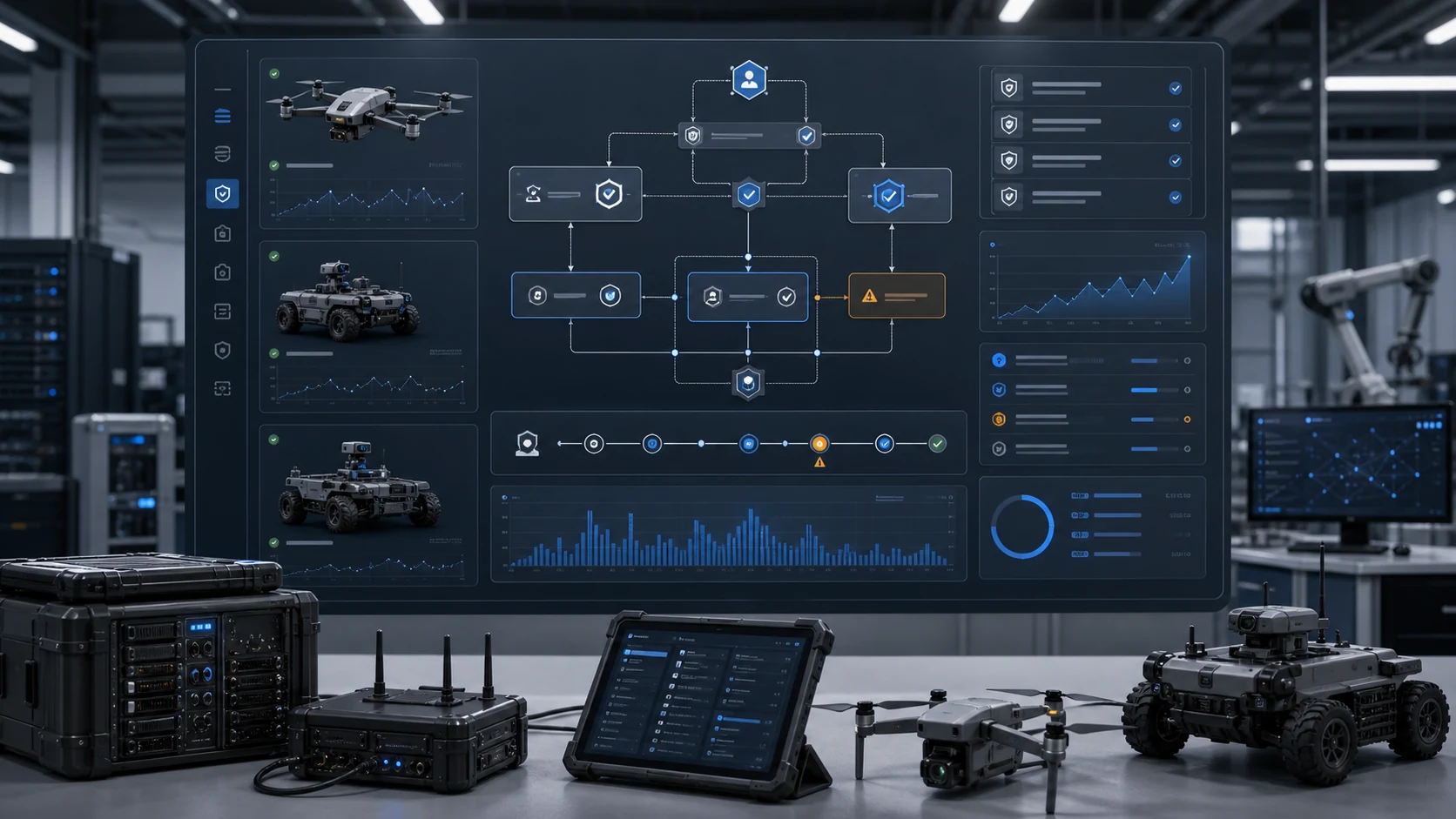
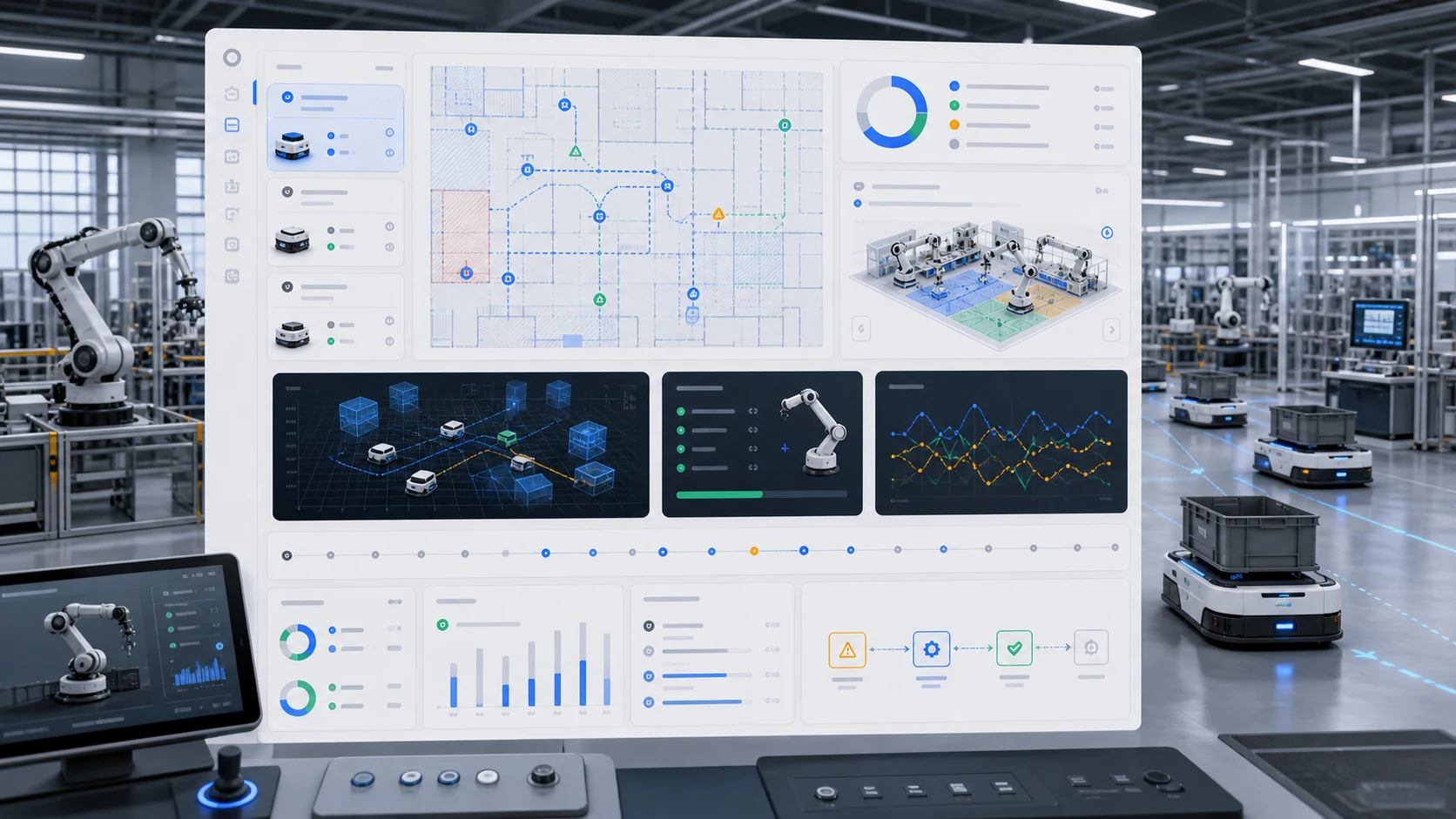
NeuralOS is most useful when the runtime is tied to a workflow: signed releases, local inference, telemetry health, OTA rollback, and evidence that NowFlow and operators can inspect.
02Architecture
Six-layer system stack, purpose-built.
Six integrated layers connect the real-time kernel to networking, assurance, autonomy, inference, and operator applications.
Linux 6.12 LTS + PREEMPT_RT fully preemptible kernelBuildroot 2025.08 with 46 custom packagesNPIE v2.0.0 unified inference layer
System stack
L01–L06L01
Applications
Neural Studio, AI Agent Hub, Drone Command Center, Quantum Lab + 29 more
L02
NPIE v2.0.0
12 inference backends -- LiteRT, ONNX, emlearn, WasmEdge, NCNN, ExecuTorch, OpenVINO, llama.cpp, whisper.cpp, stable-diffusion.cpp, MLC LLM, QuEST
L03
Robotics & Drone Stack
MAVLink 2.0, PX4 1.16.0, ArduPilot, MAVSDK, swarm engine, 16-state EKF, Remote ID
L04
Networking
WiFi mesh (802.11s + BATMAN-adv), eBPF QoS, 4G/5G cellular, WireGuard VPN, delta+LZ4 telemetry
L05
Security
Secure Boot (FIT), dm-verity, AES-256-GCM encryption, RAUC OTA with rollback, zero telemetry
L06
Kernel
Linux 6.12 LTS + PREEMPT_RT -- fully preemptible, 1000 Hz tick, SCHED_DEADLINE
03Inference layer
NPIE v2.0.0 — 12 inference backends.
Neura Parse Inference Engine provides a unified API across 12 hardware-optimized backends. Deploy models trained in any framework. 5,325 inferences/sec, 4.55 GFLOPS.
01
LiteRT
02
ONNX Runtime
03
emlearn
04
WasmEdge
05
NCNN
06
ExecuTorch
07
OpenVINO
08
llama.cpp
09
whisper.cpp
10
stable-diffusion.cpp
11
MLC LLM
12
QuEST
Backend definitionsRuntime role for each of the twelve adapters
- LiteRT
- Google's on-device ML runtime
- ONNX Runtime
- Cross-platform inference
- emlearn
- Tiny classical ML for embedded devices
- WasmEdge
- WebAssembly model runtime
- NCNN
- High-perf mobile neural network
- ExecuTorch
- PyTorch edge deployment
- OpenVINO
- Intel hardware optimization
- llama.cpp
- On-device large language models
- whisper.cpp
- On-device speech recognition
- stable-diffusion.cpp
- On-device image generation
- MLC LLM
- TVM-compiled LLM runtime
- QuEST
- Quantum circuit simulation
- Compute throughput
- 4.55 GFLOPS
- Inferences per second
- 5,325/s
- Memory bandwidth
- 28.37 GB/s
04Autonomy stack
Full autonomous flight & navigation stack.
MAVLink 2.0, PX4 Autopilot 1.16.0, swarm coordination with Raft consensus, 16-state EKF sensor fusion, and ASTM F3411 Remote ID compliance -- all pre-integrated.
- A01
MAVLink 2.0 & PX4 1.16.0
Full MAVLink 2.0 protocol with PX4 Autopilot 1.16.0, ArduPilot, and MAVSDK for autonomous flight control and mission planning.
PX4 Autopilot 1.16.0 integration
- A02
Swarm Intelligence
Multi-drone coordination with formation flying, Raft leader election for fault tolerance, and distributed task allocation.
Formation flying engine
- A03
Sensor Fusion & Navigation
16-state Extended Kalman Filter fusing GPS, IMU, barometer, magnetometer, and optical flow for centimeter-accurate positioning.
16-state EKF sensor fusion
Autonomy and networking inventoryProtocol, coordination, navigation, and constrained-link detail
MAVLink 2.0 & PX4 1.16.0
- PX4 Autopilot 1.16.0 integration
- ArduPilot support
- MAVSDK flight control library
- Remote ID compliance (ASTM F3411)
Swarm Intelligence
- Formation flying engine
- Raft leader election protocol
- Distributed task allocation
- Collision avoidance mesh
Sensor Fusion & Navigation
- 16-state EKF sensor fusion
- GPS + IMU + barometer integration
- Optical flow positioning
- Camera pipeline with OpenCV
Networking stack
- WiFi mesh (802.11s + BATMAN-adv)
- eBPF-based QoS traffic shaping
- 4G/5G cellular connectivity
- WireGuard VPN tunnels
- Delta + LZ4 telemetry compression
- MAVLink telemetry routing
05Security
Hardened from boot to runtime.
Verified boot chain, encrypted models, atomic OTA updates, and zero telemetry. Every layer locked down by default.
S02
dm-verity
S03
AES-256-GCM Model Encryption
S04
WireGuard VPN
S05
RAUC OTA with Rollback
S06
Zero Telemetry
Security control definitionsBoot, integrity, encryption, connectivity, updates, and privacy
Secure Boot (FIT)
Verified boot chain using Flattened Image Tree with cryptographic signature validation at every stage from bootloader to userspace.
dm-verity
Block-level integrity verification for read-only partitions. Detects any tampering with the root filesystem at runtime.
AES-256-GCM Model Encryption
AI models encrypted at rest and decrypted in secure memory. Protects proprietary inference models from extraction.
WireGuard VPN
Built-in WireGuard for encrypted device-to-cloud and device-to-device communication with minimal overhead.
RAUC OTA with Rollback
Atomic A/B over-the-air updates with automatic rollback on failure. Delta updates minimize bandwidth on constrained links.
Zero Telemetry
No data collection, no phone-home, no analytics. Complete privacy by design -- your fleet, your data, your control.
06Deployment estate
Hardware reach and operator tooling, held in one deployment record.
Platform targets stay visible for deployment decisions. The deeper desktop and library inventory opens only when an operator needs it.
D1Five supported platformsKVM development through Pixhawk and NVIDIA Jetson deployment
x86_64 (KVM)
Run NeuralOS as a KVM virtual machine for development, CI/CD testing, and cloud-edge simulation.
ARM64 (QEMU)
Full QEMU emulation for ARM64 development without physical hardware. Cross-compile and test on any workstation.
Raspberry Pi 4/5
Native support for Raspberry Pi 4 and 5 with hardware-accelerated video, GPIO access, and camera module integration.
Pixhawk 6X
Companion computer integration with Pixhawk 6X flight controller via MAVLink 2.0 for autonomous drone operations.
Jetson Orin Nano
NVIDIA Jetson Orin Nano with CUDA acceleration for high-performance edge AI inference up to 40 TOPS.
D2Operator shell and application inventoryQt5 QML shell, 33 built-in apps, and hybrid computing libraries
The lightweight desktop is purpose-built for embedded AI workloads: Neural Studio, Drone Command Center, Quantum Lab, and 30 additional applications.
Quantum computing libraries
- QuEST -- Quantum Exact Simulation Toolkit -- full state-vector simulation
- Qulacs -- High-performance quantum circuit simulator
- PennyLane -- Differentiable quantum computing framework
- Stim / QEC -- Quantum error correction simulation
- CUDA Quantum -- NVIDIA hybrid quantum-classical programming
Application highlights
Neural Studio
AI Agent Hub
Drone Command Center
Quantum Lab
Model Manager
Swarm Controller
Sensor Dashboard
Flight Planner
Terminal
File Manager
System Monitor
Network Manager
WireGuard VPN
OTA Updater
Camera Viewer
Log Viewer
+ 17 more applications
08Build and release
Four profiles, one build system.
Choose the profile that matches your deployment. Each includes only the packages required for its use case.
- R01
Target
Choose the hardware platform and the smallest build profile that fits the mission.
Input · platform + profile
- R02
Build
Buildroot resolves the kernel, runtime, packages, and target-specific image.
Artifact · reproducible image
- R03
Verify
Release identity, boot policy, model package, and known limits are checked before promotion.
Gate · release record
- R04
Deploy
Flash locally or move the accepted package through the controlled OTA path.
Output · device release
- R05
Observe
Runtime health, telemetry, incidents, and rollback state remain available to operators.
Evidence · health + rollback
minimal
~128 MB
Custom embedded appliances
drone
~256 MB
Autonomous drone platforms
robot
~320 MB
Robotic and edge AI devices
full
~512 MB
Development, testing, full-featured deployments
Profile package definitionsWhat each image includes and excludes
- minimal
- Base system with kernel, init, networking, and security. No AI or drone stack.
- drone
- Minimal + MAVLink, PX4, swarm engine, sensor fusion, camera pipeline, Remote ID.
- robot
- Minimal + NPIE inference engine, OpenCV, llama.cpp, sensor fusion, navigation stack.
- full
- Everything: NPIE, drone stack, quantum libs, Qt5 desktop shell with 33 applications.
Quick start
Build console# Clone the repository
$ git clone https://github.com/neuraparse/neuraos.git
$ cd neuraos
# Build for your target platform & profile
$ make neuraos_rpi5_drone_defconfig
$ make -j$(nproc)
# Flash and boot in <5 seconds
$ dd if=output/images/sdcard.img of=/dev/sdX bs=4M
Deploy edge AI
Move a signed release from build to working device.
Pick a build profile, flash the target, and preserve the runtime and rollback evidence around Linux 6.12 LTS and the NPIE inference layer.