Legacy and mixed-protocol estates
Acceptance questionCan each interface be tested, monitored, versioned, and supported by a named owner?
SLINDUSTRIAL AI + ROBOTICS
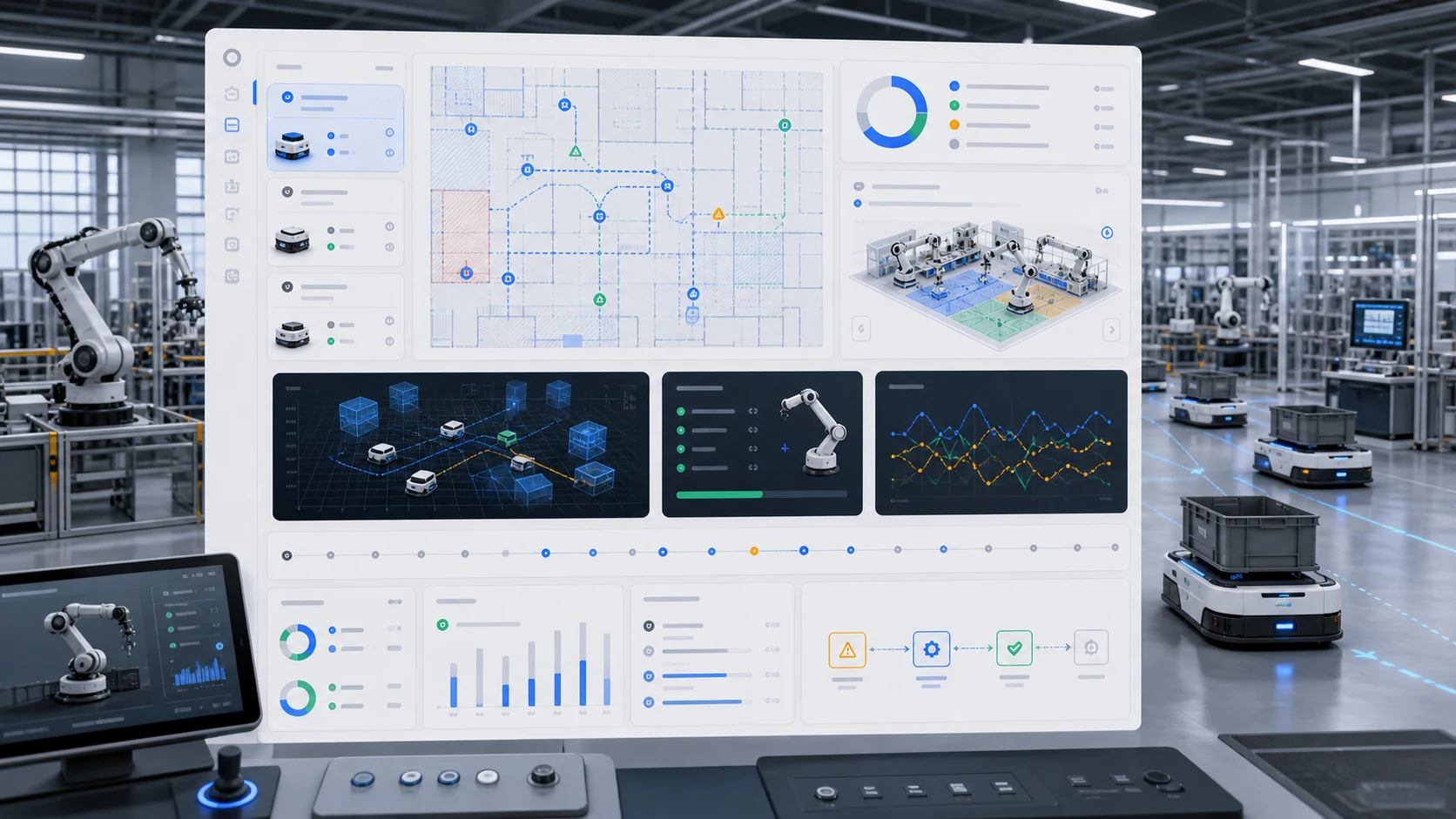
Neura Parse connects plant data, robotics, edge AI, operator workflows, maintenance, digital twins, release control, crypto-agility, and evidence. Business outcomes and performance targets are established from the customer's baseline—not published as universal percentages.
Manufacturing · Warehouse operations · Critical infrastructure · Robotics integrators
01Operating brief
Production AI lives inside equipment, networks, maintenance systems, safety procedures, shift handoffs, quality rules, and change windows. Integration and operating ownership are the real scaling problem.
Plant-floor perspective
A promising model can lose its value when the product mix changes, a camera is moved, tooling wears, a new material arrives, lighting shifts, or an operator resolves an exception differently. Industrial AI therefore needs two connected baselines: technical behavior such as precision, latency, and resource use, and operational behavior such as rework, queue time, downtime, or inspection effort. Improvement is credible only when both are measured against the current process.
Acceptance questionCan each interface be tested, monitored, versioned, and supported by a named owner?
Acceptance questionIs the pilot compared with a measured baseline and a cost model the customer accepts?
Acceptance questionCan the team distinguish data drift, equipment drift, model drift, and process change?
Acceptance questionWho owns the exception, what is the safe state, and how is the event replayed?
The integration path is usually more consequential than the demo. PLCs, robots, historians, MES, WMS, CMMS, enterprise systems, and custom equipment often have different owners, maintenance windows, clocks, and failure semantics. Interfaces need versioned contracts, observable health, bounded retries, safe fallback, and a named support path. Operators and maintenance teams should be able to understand what the system saw, what it proposed, and how to continue when it is unavailable.
Long-lived operational technology also makes lifecycle ownership and crypto-agility first-class concerns. Models, device images, certificates, signing systems, gateways, and supplier libraries change on different schedules. An inventory-led post-quantum readiness program can identify trust paths and long-lived dependencies without declaring the plant quantum-safe. The practical goal is controlled change: testable releases, staged deployment, rollback, and evidence that remains useful across shifts, sites, and equipment generations.
Legacy and mixed-protocol estates. PLCs, robots, cameras, historians, MES, CMMS, WMS, ERP, and custom equipment expose different data, timing, ownership, and reliability characteristics.
Unclear baseline and economics. Generic downtime, accuracy, or throughput claims obscure the current process, defect cost, maintenance pattern, and operational bottleneck.
Model and process drift. Lighting, materials, tooling, routes, product mix, sensors, and operator behavior change. Detection quality and workflow impact must be monitored separately.
Safe exception handling. AI should not silently control high-consequence equipment. Low confidence, unavailable sensors, conflicting rules, and unexpected states need an explicit safe and human-owned path.
02Operator loop
The loop connects data quality, model behavior, operator disposition, equipment action, and maintenance or engineering follow-up.
Map equipment, signals, events, clocks, owners, quality, and process context before selecting a model.
Evidence · Asset map · signal contract · baseline · data-quality profile
Compare model or rule approaches on representative data and operating conditions with cost-sensitive acceptance metrics.
Evidence · Dataset record · baseline · error analysis · acceptance plan
Connect inference to operator review, MES, WMS, CMMS, robot, PLC, or quality workflow with safe fallback and observability.
Evidence · Interface test · approval path · rollback · runbook
Monitor equipment, data, model, workflow, incidents, maintenance outcomes, and business metrics on separate but linked views.
Evidence · Operational dashboard · incident · drift · improvement backlog
03System map
Every capability begins with the customer's asset profile and baseline. Throughput, accuracy, availability, power, ROI, and cryptographic migration become acceptance questions—not marketing constants.
Connect mission or job dispatch, robot readiness, map and zone context, charge cycles, exceptions, maintenance, and operator handoff.
Evaluate and deploy vision models with sample traceability, cost-sensitive error analysis, reviewer workflow, drift checks, and MES disposition.
Connect vibration, acoustic, thermal, current, or event signals to asset context, anomaly review, work orders, and maintenance outcomes.
Package models for industrial PCs or edge devices with target benchmarks, signed release identity, health signals, staged rollout, and rollback.
Connect system models, live data, what-if scenarios, software- or hardware-in-the-loop tests, and engineering decisions.
Inventory long-lived device identity, remote access, VPN, PKI, software and firmware signing, protocol, library, appliance, and supplier dependencies; then prioritize a bounded standards-based migration pilot.
Reference layers
Low-level safety and motion control remain with qualified equipment. Edge intelligence and operations workflows integrate through bounded, observable interfaces.
PLC · robot controller · safety PLC · machine vision · condition sensors
OPC UA · MQTT · ROS 2/DDS · vendor APIs · time synchronization
NeuralOS · model runtime · industrial PC · edge camera · signed release
MES · WMS · CMMS · ERP · approvals · notifications
Baseline · run record · drift · CBOM · incident · CAPA · release and rollback history
Equipment and control. Robots, PLCs, sensors, cameras, drives, safety systems, and existing vendor controls remain the authoritative equipment layer.
Industrial connectivity. Protocol adapters normalize messages and preserve asset, time, quality, and security context.
Edge intelligence. Local models, preprocessing, policy, buffering, health, and device update controls run close to the process.
Operations workflow. NowFlow connects alerts, review, dispatch, quality disposition, work orders, engineering change, and enterprise systems.
Evidence and improvement. Production, model, workflow, maintenance, security, supplier, and business evidence remain linked to the configuration and decision that produced them.

04Field evidence
The profile defines what to measure and who acts. It intentionally avoids universal claims about accuracy, downtime reduction, throughput, or payback.
Decision · Which robot should execute the job, and when should a person intervene?
Decision · Accept, reject, rework, hold, or request expert review?
Decision · Inspect now, plan work, continue monitoring, or dismiss the alert?
Decision · Which scenario merits a controlled plant trial?
Decision · Which dependency or representative trust boundary should enter the first controlled migration pilot?
Coordinate jobs, readiness, zones, charge, traffic exceptions, WMS integration, maintenance, and human takeover across a mixed fleet.
Screen parts at the line, preserve image and part identity, route uncertain findings, record disposition, and monitor process and data drift.
Combine condition signals with asset state and history, prioritize review, open work, and compare prediction with the eventual maintenance outcome.
Evaluate scheduling, configuration, fault, capacity, or maintenance scenarios against a bounded model before changing the physical process.
Trace public-key cryptography through one device or cell lifecycle, including provisioning, remote service, software and firmware signing, certificates, vendor libraries, update, revocation, and recovery.
Industrial standards and protocols define interfaces, security, and lifecycle inputs. Conformance, safety integrity, and site approval remain product- and customer-specific. These are design inputs, not certification claims.
Model assets, methods, events, security, and interoperability through versioned, testable interfaces.
Integration referenceFrame AI context, measurement, governance, documentation, and ongoing risk management around the real use case.
Assurance referenceMap identity, protection, detection, response, recovery, suppliers, and operating ownership around connected industrial systems.
Security referenceAnchor ML-KEM, ML-DSA, and SLH-DSA inventory, supplier evidence, interoperability testing, staged migration, and crypto-agility decisions.
Migration referenceThe equipment provider, integrator, and site owner define safety functions, validation, change control, and approval.
Customer-ledNIST
Primary risk-management context for trustworthy AI design, measurement, governance, documentation, and lifecycle operation.
Open ↗R02NIST
Primary context for governing and managing cybersecurity risk across organizations and supply chains.
Open ↗R03OPC Foundation
Primary protocol and information-model context for secure industrial interoperability.
Open ↗R04ROS
Primary ecosystem reference for robotics middleware and integration; deployment suitability remains program-specific.
Open ↗R05NIST
Primary source for standardized ML-KEM, ML-DSA, and SLH-DSA plus the migration programme relevant to long-lived industrial devices, signing, identity, remote access, and supplier dependencies.
Open ↗05Deployment path
Choose one delivery route, then inspect the supporting analysis only when needed.
Industrial pilot
We can map the asset and data interfaces, model or workflow candidate, target-device benchmark, operator handoff, and evidence needed to justify the next rollout stage.