
P01
Human authority
Decision questionWhich actions may run automatically, which require confirmation, and who can stop, reverse, or escalate the workflow?
SVMission AI & Agentic Systems
Design approval-gated AI workflows that connect models, tools, operators, data, and evidence across real systems.
Mission and operations teams · Regulated workflows · Enterprise platform owners
 Concept visualization
Agentic workflow delivery
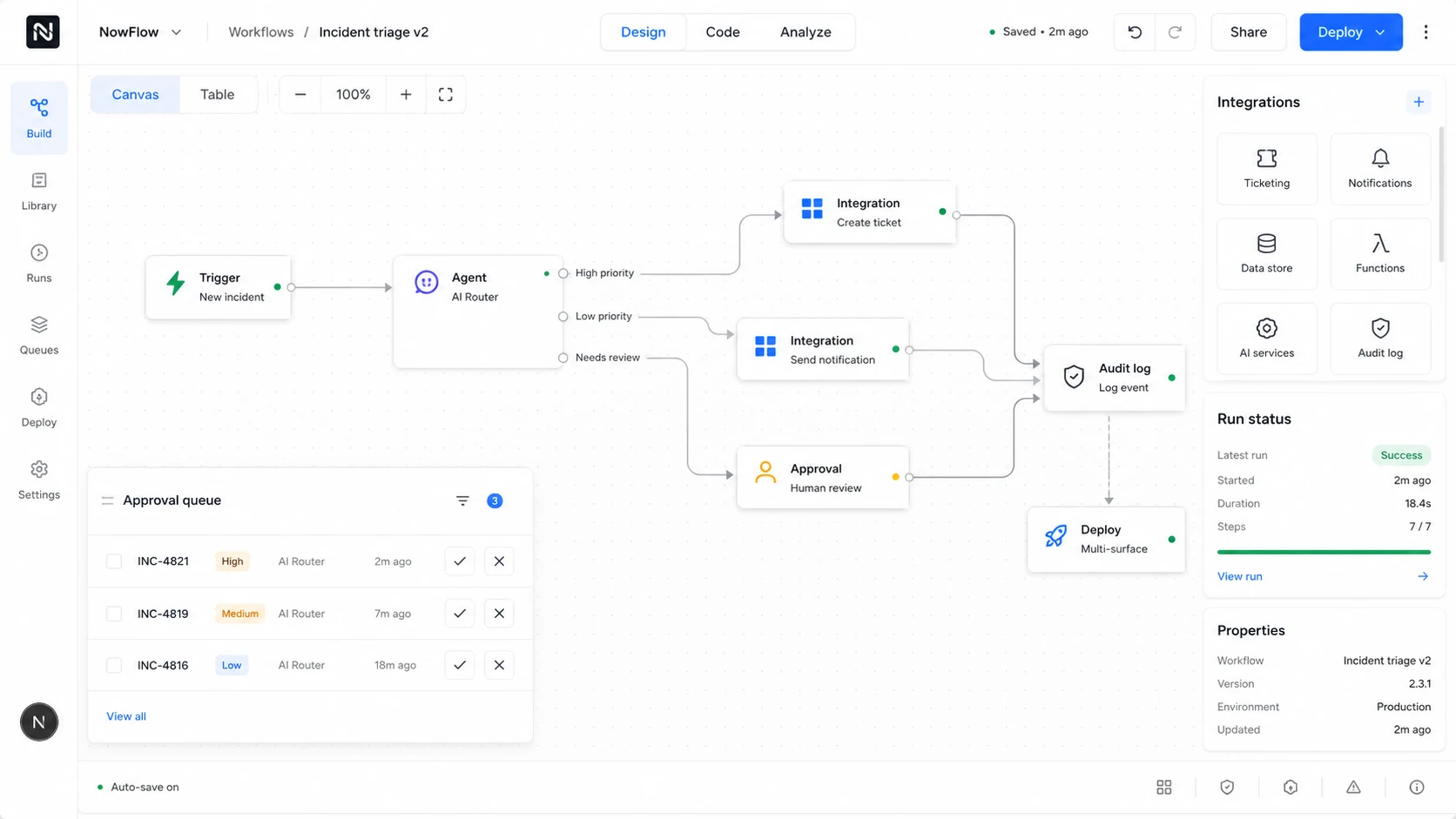
Workflow discovery maps triggers, specialist work, approvals, exceptions, integrations, and production ownership before an agentic implementation is selected.
Layer 01
Layer 02
Layer 03
Layer 04
01 · Mission context
Mission and enterprise workflows cross people, models, tools, records, and approval boundaries. Agentic automation must therefore be designed as a controlled operating system for a specific workflow, not as an unconstrained chatbot with broad credentials.
Authority design
A useful automation design starts by reconstructing how a real case moves from trigger to disposition. Sources, handoffs, approvals, exceptions, and downstream consequences are mapped before any model or tool is selected. This exposes where deterministic validation is sufficient, where probabilistic assistance is acceptable, and where a named person must retain the decision.
P01
Decision questionWhich actions may run automatically, which require confirmation, and who can stop, reverse, or escalate the workflow?
P02
Decision questionWhich sources and tools are authoritative for each step, and how is least-privilege access enforced and recorded?
P03
Decision questionWhat should retry, queue, degrade, fail closed, require an operator, or roll back when a dependency fails?
P04
Decision questionWhat test set and release evidence must pass before a workflow version is allowed to act in the target environment?
Actions are then classified by authority rather than convenience. Read-only retrieval, draft preparation, approval-gated writes, and prohibited operations receive different identities, permissions, evidence, and recovery behavior. The resulting workflow is easier to review because the agent cannot silently widen its role when a source, prompt, model, or tool changes.
Human authority. If recommendation, approval, execution, and override rights are not separated, operators cannot tell where automation ends and accountability begins.
Grounded tool use. An agent can produce a fluent answer while reading the wrong source, calling the wrong tool, or acting with more privilege than the task requires.
Failure and recovery. Timeouts, malformed data, unavailable tools, model refusal, duplicated events, and partial writes create operational risk that prompt design alone cannot solve.
Evaluation and change control. Model, prompt, policy, tool, and source changes can alter workflow behaviour even when the user interface looks unchanged.
02 · Delivery system
Inputs, outputs, maturity, and the evidence boundary travel together. Capability is never separated from the condition under which it can be accepted.
Map the real workflow from trigger to decision and outcome, including operator roles, handoffs, approval points, prohibited actions, and exception paths.
Output · Workflow model, authority matrix, escalation map, tool permissions, state transitions, and bounded pilot definition.
Compose specialist agents, deterministic services, retrieval, APIs, and validation steps around explicit contracts rather than one general-purpose prompt.
Output · Agent topology, prompt and policy versions, tool adapters, context rules, structured outputs, and provenance records.
Test task quality, authority enforcement, prompt injection resistance, source handling, tool misuse, failure recovery, and operator comprehension with representative cases.
Output · Evaluation harness, trace set, issue register, mitigations, residual-risk record, and pilot release recommendation.
Release the bounded workflow with telemetry, version control, approval queues, incident ownership, rollback, user guidance, and an evidence-led review cadence.
Output · Deployed pilot, dashboards, runbooks, training, release manifest, incident path, rollback procedure, and handover pack.
Map the real workflow from trigger to decision and outcome, including operator roles, handoffs, approval points, prohibited actions, and exception paths.
Compose specialist agents, deterministic services, retrieval, APIs, and validation steps around explicit contracts rather than one general-purpose prompt.
Test task quality, authority enforcement, prompt injection resistance, source handling, tool misuse, failure recovery, and operator comprehension with representative cases.
Release the bounded workflow with telemetry, version control, approval queues, incident ownership, rollback, user guidance, and an evidence-led review cadence.
03 · System boundary
The operating architecture keeps workflow state, policy decisions, model context, tool calls, and human approvals correlated under one case identity. Representative and adversarial runs are used to exercise unavailable tools, malformed inputs, duplicate events, missing authority, and partial execution before a release is considered for the target environment.
Reference layers support scoping. Interfaces, owners, and target-system constraints remain subject to validation.
Present task state, evidence, uncertainty, requested approvals, and recovery options in the surfaces where authorised users already work.
Typical elements · Operations console, case workspace, chat surface, approval inbox, alert, and structured handoff.
Control workflow state, agent routing, deterministic checks, authority gates, timeouts, retries, and fail-closed behaviour.
Typical elements · State machine, policy engine, human approval, guard conditions, scheduler, and rollback coordinator.
Give each step only the models, sources, APIs, credentials, and context required for its declared task.
Typical elements · Model gateway, retrieval index, system-of-record adapter, sandboxed tool, secrets broker, and schema validator.
Retain versioned traces and operational signals needed to investigate decisions, compare releases, respond to incidents, and improve the workflow.
Typical elements · Evaluation runs, provenance, approval history, tool-call log, latency and error telemetry, incident record, and release manifest.
Handover defines how operators see uncertainty, pause or reverse a run, and escalate an exception. It also names the owners of telemetry, incidents, prompt and policy changes, source updates, and rollback. Expansion beyond the bounded pilot becomes a new evidence decision rather than an assumption carried forward from a successful demonstration.
04 · Assurance dossier
The primary story remains calm; profiles, scope, handover evidence, and discovery questions stay available as a structured technical annex.
Incoming documents and reports must be classified, extracted, cross-referenced, and prepared for analyst review without allowing the agent to make the operational decision.
A maintenance team combines manuals, telemetry, parts records, and work orders while connectivity and tool availability may vary.
A business process spans email, documents, internal policy, CRM or ticket records, and approvals with retention and segregation requirements.
Included in this service pattern
Not implied by this page
Handover evidence
Representative workflow runs preserve the triggering event, source versions, model and prompt versions, tool calls, validation results, approvals, and final state.
Negative tests show that prohibited actions, missing approvals, excess permissions, and untrusted instructions cannot silently bypass the declared policy path.
Injected model, tool, network, and malformed-data failures produce the agreed queue, retry, fail-closed, escalation, or rollback behaviour without hidden partial execution.
The approved workflow version is evaluated against representative and adversarial cases using client-agreed task, safety, and operator-review criteria.
Discovery questions
Evidence register
References shape requirements and review questions. Inclusion does not imply certification, endorsement, partnership, or approval by the publisher.
05 · Engagement record
Inspectable outputs close the engagement; related services point only to the next bounded step.
Deliverables
Engagement artifacts
05 records per engagement
Mission AI & Agentic Systems
Build an authority-aware workflow with inspectable tool use, evaluation evidence, escalation, containment, and handover.