
Clinical workflow fit
Acceptance questionDoes the right person receive the right evidence at a point where they can safely act?
SLHEALTHCARE AI + LIFE SCIENCES
Neura Parse supports workflow, integration, local-processing, research, and evidence-system engineering. We do not represent a general-purpose platform as a clinically validated, HIPAA-compliant, FDA-cleared, or CE-marked medical device without product- and deployment-specific evidence.
Clinical operations · Health IT · Medical-device teams · Life-sciences R&D

01Mission brief
A useful system must fit clinical roles, patient context, interoperability, privacy, safety, model limitations, escalation, procurement, validation, and post-deployment monitoring.
Clinical-workflow perspective
Healthcare AI should begin with an intended use, a named user, and the decision the system is meant to support. The same output can be helpful in one workflow and unsafe or distracting in another. Presentation timing, uncertainty, source context, escalation, override, and responsibility therefore belong in the design alongside model performance. A clinician or researcher needs to see enough evidence to judge the output without being encouraged to surrender professional authority to it.
Acceptance questionDoes the right person receive the right evidence at a point where they can safely act?
Acceptance questionCan data lineage, patient identity, terminology, transformation, and access be audited end to end?
Acceptance questionIs the evaluation representative of the intended users, data, setting, and decision?
Acceptance questionCan the team detect drift, assess impact, approve change, and roll back safely?
Interoperability and privacy shape what is technically possible. Images, observations, laboratory results, notes, device streams, identity, consent, and terminology may cross DICOM, HL7, FHIR, and local interfaces with different semantics. Local or edge processing can reduce latency or data movement in some settings, but it does not remove the need for access control, purpose limitation, lineage, cybersecurity, retention, and site-specific validation.
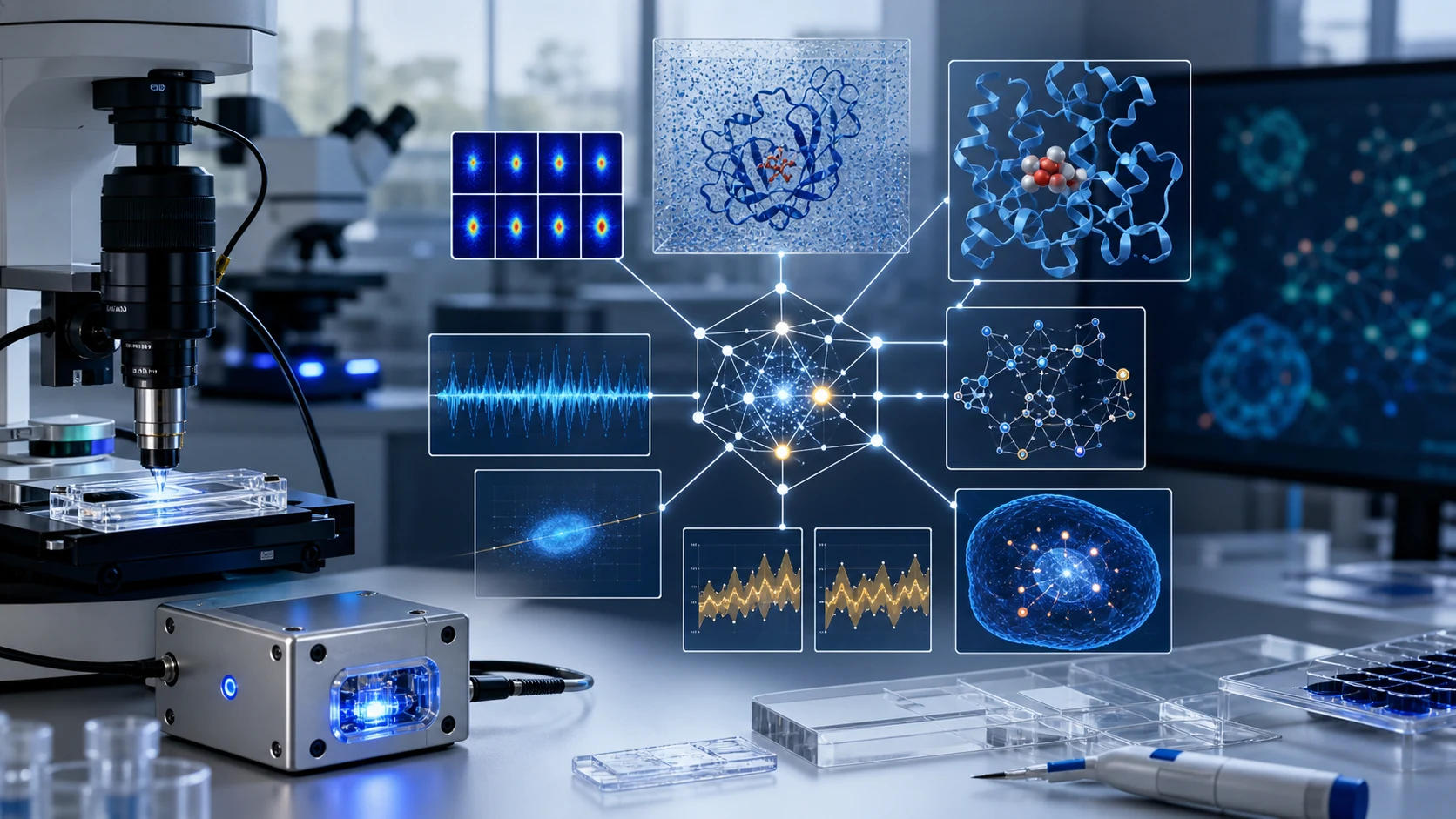
Quantum sensing and quantum-enabled biomedical research should be treated as research programs, not clinical claims. A meaningful study defines the physical signal, protocol, controls, calibration, classical comparator, uncertainty, and negative-result policy before choosing a quantum technique. That discipline creates useful evidence even when a proposed advantage is not observed, and it keeps exploratory work clearly separated from diagnostic, therapeutic, or regulated product assertions.
Clinical workflow fit. A technically accurate output can still create delay, alarm fatigue, duplicate work, automation bias, or unclear responsibility if it arrives in the wrong workflow.
Data and interoperability. DICOM, HL7 v2, FHIR, device streams, laboratory data, notes, identities, consent, and local mappings carry different semantics and governance.
Clinical and technical validation. Model performance varies by population, site, device, protocol, prevalence, workflow, and intended use. Benchmarks do not substitute for the applicable validation pathway.
Lifecycle monitoring and change. Models, datasets, devices, clinical practice, software dependencies, and regulations evolve. Each change may affect the validated state.
02Operator loop
The operating loop preserves patient and protocol context, model version, uncertainty, clinician disposition, and downstream outcome without presenting AI as autonomous clinical authority.
Receive the minimum necessary data with identity, consent, device, protocol, quality, terminology, and access context.
Evidence · Data lineage · consent/access · protocol · quality record
Run a model or rule set inside its intended-use boundary and attach version, limitations, uncertainty, and relevant source evidence.
Evidence · Model version · input quality · output · uncertainty · limitations
Present information in the clinician or researcher workflow with escalation, override, rationale, and clear responsibility.
Evidence · Reviewer identity · disposition · escalation · action receipt
Track technical behavior, data drift, workflow impact, safety events, feedback, and authorized changes separately.
Evidence · Monitoring record · incident · change assessment · updated validation
03System map
Capabilities support engineering and research. Intended use, clinical performance, privacy obligations, cybersecurity, quality management, and regulatory approval are established for the specific product and deployment.
Route referrals, second reads, alerts, exceptions, documentation, research tasks, and approvals with role, timing, escalation, and audit context.
Map and test DICOM, HL7 v2, FHIR, identity, terminology, device, and local-system interfaces with explicit transformation and ownership.
Package approved models for local infrastructure or devices with target benchmarks, access controls, observability, release identity, and controlled export.
Define intended use, populations, sites, devices, reference standard, error costs, workflow outcomes, subgroup review, drift, and change controls.
Structure protocols, calibration, controls, classical baselines, resource estimates, privacy boundaries, uncertainty, and negative results.
Reference layers
The reference flow separates source systems, local processing, workflow orchestration, clinician review, and evidence so each boundary can be governed and validated.
DICOM · HL7 v2 · FHIR · device interface · controlled research data
Interface engine · IAM · consent · terminology · lineage · audit
NeuralOS where appropriate · local server · model runtime · QFlow research record
Role-specific queue · human review · exception · action receipt
Protocol · model card · monitoring · change assessment · CAPA
Clinical and research sources. EHR, PACS, LIS, devices, imaging, notes, research datasets, protocol, identity, consent, and terminology remain authoritative at source.
Interoperability and governance. Mapping, identity, access, consent, minimum-necessary data, terminology, transformation, retention, and audit are explicit services.
Local intelligence and research compute. Approved models or experiments run on defined infrastructure with version, input checks, observability, and export policy.
Clinician and researcher workflow. NowFlow connects review, escalation, second read, documentation, protocol tasks, approvals, and downstream systems.
Validation and lifecycle evidence. Evaluation, limitations, incidents, drift, change, retraining, cybersecurity, and regulatory artifacts remain tied to the product version and intended use.
04Field evidence
Profiles are framed as workflow, integration, and evaluation work. They do not claim clinical accuracy, device approval, or regulatory compliance.
Decision · Accept, reject, investigate, or escalate the model-supported finding?
Decision · Which alert needs immediate review, routine follow-up, or dismissal?
Decision · Is the result reproducible and appropriate for the next research step?
Decision · Does evidence justify another experiment, hardware run, or termination?
Route a validated model output beside source images and clinical context for specialist review, uncertainty handling, discrepancy tracking, and escalation.
Aggregate authorized alerts, patient and device context, suppress duplicate workflow noise, and route prioritized items to the accountable clinical role.
Run approved research models inside a controlled environment with dataset identity, access, reproducible configuration, result export, and audit.
Compare a sensing or simulation method with classical baselines under a pre-registered protocol, calibration plan, uncertainty, and privacy constraints.
Healthcare laws, standards, and approvals attach to a specific legal entity, intended use, product, market, site, and operating model. They are design inputs here—not blanket badges. These are design inputs, not certification claims.
Map lawful basis, roles, minimum necessary data, access, security, retention, patient rights, incident response, and contractual responsibilities.
Deployment-specificDefine semantic and transport interoperability, terminology, identity, validation, error handling, and local profiles.
Integration referenceIntended use, classification, quality management, risk, clinical evaluation, cybersecurity, software lifecycle, and post-market monitoring require a sponsor-led pathway.
Sponsor-ledAssess role, risk classification, data governance, transparency, human oversight, accuracy, robustness, cybersecurity, and monitoring where applicable.
Legal assessmentFDA
Primary U.S. context for AI-enabled medical devices and the importance of product-specific authorization and lifecycle oversight.
Open ↗R02HL7
Primary standard reference for healthcare data resources, APIs, implementation guides, and conformance.
Open ↗R03DICOM Standards Committee
Primary imaging-interoperability context for medical images, related information, services, and conformance.
Open ↗R04European Commission
Primary EU policy context for AI risk, obligations, implementation, and governance.
Open ↗R05NIST
Current primary metrology context for quantum sensor types, measurement principles, calibration considerations, limitations, and possible biomedical applications.
Open ↗R06NIST
Primary research context for quantum-light methods in biological measurement and imaging; it supports protocol and analytical-evidence framing, not a clinical-readiness claim.
Open ↗05Deployment path
Choose one delivery route, then inspect the supporting analysis only when needed.
Healthcare and life-sciences review
We can scope workflow and integration engineering, local-processing evaluation, research evidence, and governance without implying clinical validation or regulatory status that has not been established.