
P01
Service ownership
Decision questionWho owns detection, diagnosis, containment, approval, communication, recovery, and residual-risk decisions for each component?
SVManaged AI & Model Operations
Operate models, workflows, and edge releases through agreed telemetry, incident, change, and governance processes.
Enterprise AI teams · Large device fleets · Consequential or distributed systems
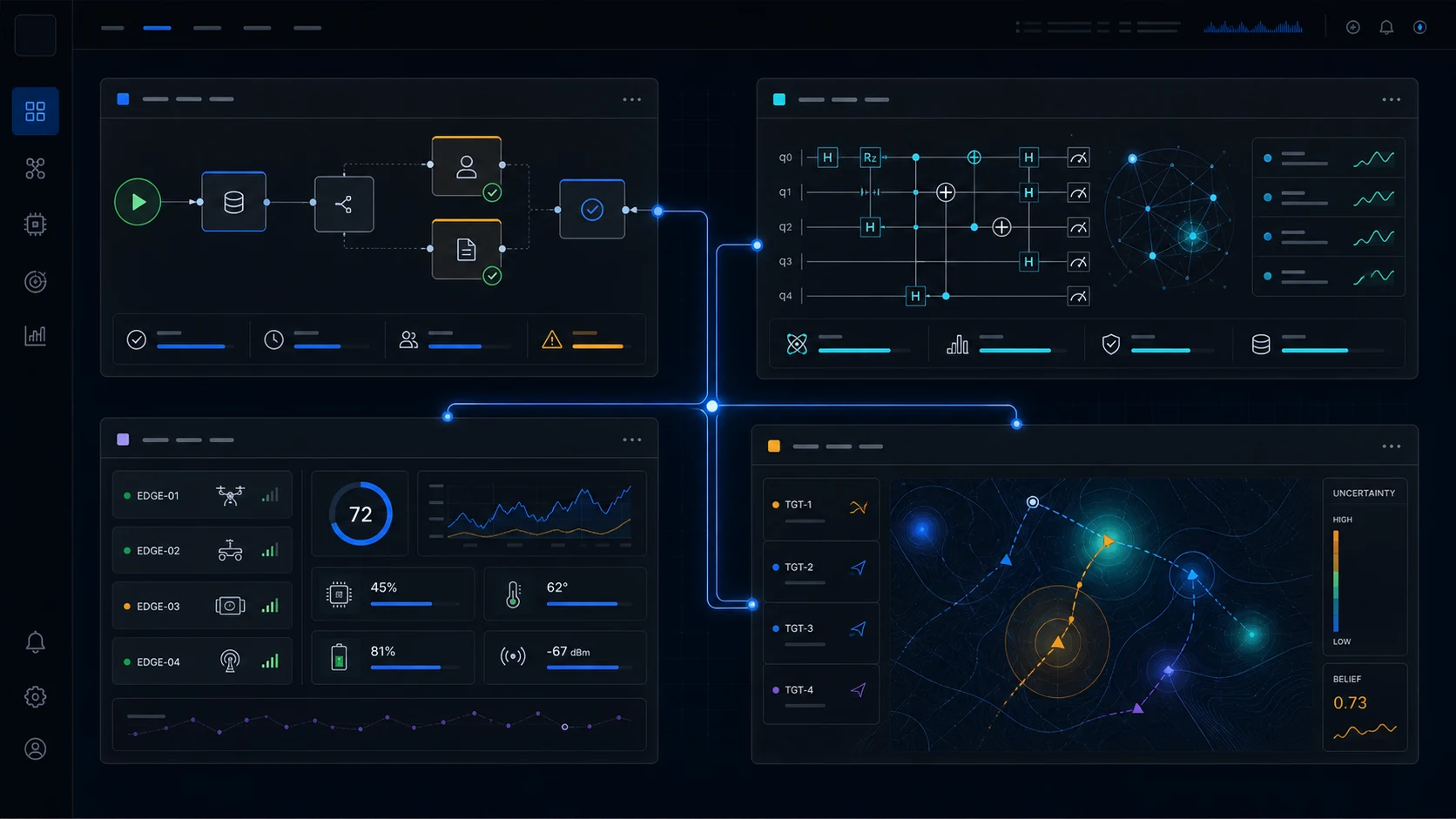
 Concept visualization
Managed operations
Managed service delivery is framed around production infrastructure, agreed telemetry, incident response, model or data checks, controlled releases, and executive review.
Layer 01
Layer 02
Layer 03
Layer 04
01 · Mission context
Models, agent workflows, and edge releases change after launch. A credible managed service defines what is observed, who owns each response, how releases are controlled, which evidence is retained, and where client or supplier responsibilities begin and end.
Service boundary
Onboarding defines the managed unit as a chain of models, prompts, data, tools, APIs, edge packages, user surfaces, and suppliers rather than a single endpoint. Each component needs an accountable owner, an access path, a known support dependency, and enough telemetry to investigate its contribution to the service outcome.
P01
Decision questionWho owns detection, diagnosis, containment, approval, communication, recovery, and residual-risk decisions for each component?
P02
Decision questionWhich technical, task, safety, security, cost, and user signals represent the health of the actual AI-enabled service?
P03
Decision questionWhich changes require evaluation, staged release, approval, rollback readiness, and post-change observation?
P04
Decision questionWhich improvement is justified by evidence, what must be retested, and who accepts the new trade-off?
Health is then expressed in the language of the actual task. Infrastructure and application signals are combined with data freshness, evaluation drift, policy decisions, tool failures, operator overrides, device state, security events, and cost. Blind spots remain named so an absence of alerts is not mistaken for evidence that the service is behaving correctly.
Service ownership. If model, application, data, platform, security, vendor, and business owners are not separated, alerts circulate without a person authorised to act.
Observable service health. Infrastructure uptime alone cannot show whether data is stale, model behaviour has shifted, tools are failing, operators are overriding output, or policy gates are blocking work.
Incident and change control. A model, prompt, policy, data, dependency, device, or configuration update can create a new failure without a traditional code release.
Sustainable improvement. Retraining, provider switching, prompt tuning, hardware updates, and cost optimisation can create hidden regressions when treated as routine maintenance.
02 · Delivery system
Inputs, outputs, maturity, and the evidence boundary travel together. Capability is never separated from the condition under which it can be accepted.
Inventory workloads, owners, dependencies, users, data, model and release versions, support paths, known risks, and current telemetry before accepting an operating role.
Output · Service catalogue, dependency and ownership map, observability gaps, operational risk register, onboarding backlog, and agreed responsibility matrix.
Correlate infrastructure, application, data, model, workflow, edge, security, cost, and operator signals into service-specific health and investigation views.
Output · Signal catalogue, dashboards, alert rules, evidence retention, triage context, known blind spots, and agreed reporting view.
Operate severity classification, triage, escalation, containment, evidence capture, staged change, approval, rollback, recovery validation, and communication.
Output · Runbooks, incident timeline, decision log, release record, recovery evidence, post-incident review, corrective actions, and unresolved-risk escalation.
Review service behaviour, recurring incidents, drift, user overrides, evaluation changes, cost, capacity, security findings, and technical debt before proposing change.
Output · Service review, prioritised improvement backlog, change hypothesis, required retests, risk decisions, lifecycle recommendation, and executive summary.
Inventory workloads, owners, dependencies, users, data, model and release versions, support paths, known risks, and current telemetry before accepting an operating role.
Correlate infrastructure, application, data, model, workflow, edge, security, cost, and operator signals into service-specific health and investigation views.
Operate severity classification, triage, escalation, containment, evidence capture, staged change, approval, rollback, recovery validation, and communication.
Review service behaviour, recurring incidents, drift, user overrides, evaluation changes, cost, capacity, security findings, and technical debt before proposing change.
03 · System boundary
The operating control plane connects alerts to severity, authority, containment, communication, recovery, and the exact version in use. Model, prompt, policy, dependency, and device changes follow the same staged evidence path, with required evaluation, approval, observation, and rollback defined before a maintenance window begins.
Reference layers support scoping. Interfaces, owners, and target-system constraints remain subject to validation.
Define the managed unit as a service composed of models, prompts, tools, APIs, data, edge packages, user surfaces, and third-party dependencies.
Typical elements · Model endpoint, agent workflow, retrieval service, edge release, approval queue, data pipeline, and operator console.
Collect correlated service, task, data, model, workflow, security, device, user, and cost evidence with known ownership and retention.
Typical elements · Trace, metric, log, model evaluation, drift signal, data-quality check, approval event, device health, and user feedback.
Coordinate alerting, incident state, access, change approval, release rings, configuration, containment, rollback, and vendor escalation.
Typical elements · Service catalogue, on-call route, runbook, policy gate, artifact registry, change record, feature control, and recovery workflow.
Turn operational evidence into risk decisions, corrective actions, reevaluation, service reviews, roadmap changes, and retirement when appropriate.
Typical elements · Risk register, post-incident review, control evidence, improvement backlog, lifecycle review, executive report, and retirement plan.
Handover confirms coverage conditions, escalation routes, supplier responsibilities, retained evidence, and the forum that reviews recurring incidents and improvement proposals. Changes are accepted against a stated hypothesis and retest plan, while components without agreed ownership, access, or observability remain visibly outside the managed boundary.
04 · Assurance dossier
The primary story remains calm; profiles, scope, handover evidence, and discovery questions stay available as a structured technical annex.
An enterprise model endpoint supports applications with changing data, model versions, provider dependencies, capacity needs, and business consequences.
Several approval-gated workflows use models, retrieval, internal tools, and third-party APIs with different business and security owners.
A distributed fleet runs versioned models and software under variable connectivity, hardware health, and staged update conditions.
Included in this service pattern
Not implied by this page
Handover evidence
Every in-scope component, dependency, owner, coverage condition, critical signal, known blind spot, escalation path, and retained evidence source is recorded and reviewed.
A representative scenario completes detection, triage, authority check, containment, evidence capture, communication, recovery validation, and corrective-action assignment.
A candidate model, prompt, policy, dependency, or edge release carries required evaluation evidence, approval, staged deployment, observation, and tested rollback criteria.
The reporting pack distinguishes observed facts, thresholds, incidents, unresolved risks, improvement hypotheses, owners, required tests, and lifecycle decisions.
Discovery questions
Evidence register
References shape requirements and review questions. Inclusion does not imply certification, endorsement, partnership, or approval by the publisher.
05 · Engagement record
Inspectable outputs close the engagement; related services point only to the next bounded step.
Deliverables
Engagement artifacts
04 records per engagement
Managed AI & Model Operations
Define the monitoring, incident, change, review, and support model the deployment actually requires.