
Mixed-criticality architecture
Acceptance questionAre responsibilities and failure containment explicit across compute, network, software, and safety mechanisms?
SLAUTOMOTIVE AI + MOBILITY
Neura Parse supports data, workflow, simulation, edge-runtime, fleet, integration, and vehicle-lifecycle crypto-agility for mobility programs. We do not claim ISO 26262 compliance, production-driving performance, fleet scale, homologation, automated-driving readiness, or quantum-safe status without program-specific evidence.
Mobility programs · Vehicle software teams · Fleet operators · Automotive integrators
01Operating brief
Sensors, ECUs, networks, real-time behavior, safety concepts, cybersecurity, update campaigns, fleet variation, data governance, service operations, and regulatory obligations all shape the usable capability.
Vehicle-lifecycle perspective
Vehicle intelligence moves through a chain that begins with requirements and scenarios and continues through models, sensors, ECUs, vehicle networks, target compute, fleet services, update infrastructure, incidents, and workshop operations. A result on a development machine says little about timing, thermal behavior, sensor variation, fault containment, or serviceability on the target platform. Each release needs to remain tied to the vehicle configuration and evidence that justified it.
Acceptance questionAre responsibilities and failure containment explicit across compute, network, software, and safety mechanisms?
Acceptance questionDoes evaluation cover the intended ODD, sensor set, failure modes, and data distribution?
Acceptance questionCan the team target, verify, monitor, pause, and roll back an update by configuration?
Acceptance questionIs every collected signal necessary, governed, secured, and tied to an owner and decision?
Fleet operation adds another layer of controlled variation. Hardware generations, regional configurations, supplier components, calibration, connectivity, and usage patterns affect whether an update is compatible. OTA governance should define prerequisites, cohorts, authorization, staged rollout, installation proof, health monitoring, pause conditions, and rollback before a campaign begins. Telemetry then has a specific operational purpose rather than becoming an unbounded collection exercise.
The same lifecycle extends to cryptographic identity, secure boot, diagnostics, backend services, and software or firmware signing. Post-quantum readiness starts by mapping those trust paths, their data and certificate lifetimes, hardware constraints, supplier dependencies, and recovery mechanisms. Crypto-agility is the near-term engineering outcome: the ability to test and replace algorithms or components in stages without implying that an entire vehicle platform has already achieved quantum-safe status.
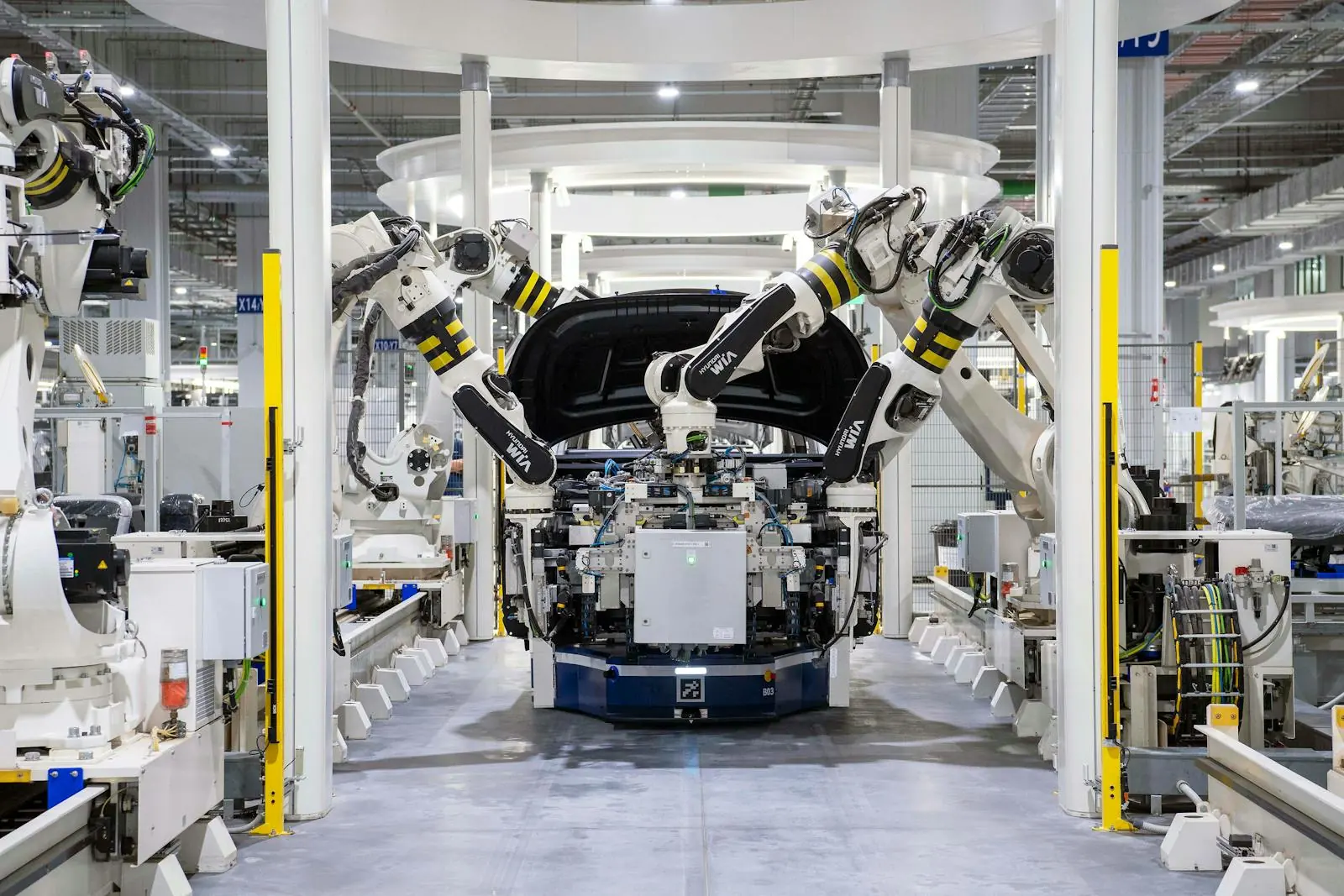
Mixed-criticality architecture. Perception, planning, diagnostics, infotainment, connectivity, fleet, and safety functions have different timing, assurance, isolation, and update needs.
Sensor and ODD variation. Weather, lighting, geography, road type, speed, sensor configuration, calibration, and vehicle condition change model behavior.
OTA and configuration control. Firmware, models, maps, calibration, policies, and applications must remain compatible across vehicle variants and phased campaigns.
Fleet evidence and privacy. Telemetry and incident data need purpose limitation, driver and passenger privacy, retention, consent or lawful basis, security, and operational value.
02Operator loop
The loop connects engineering assumptions, target hardware, vehicle configuration, test results, update campaigns, incidents, and service feedback.
Define the function, ODD, architecture, interfaces, safety and security assumptions, data, and acceptance metrics.
Evidence · Requirements · architecture · hazard and threat inputs · data plan
Exercise software, model, scenario, timing, network, sensor, and failure behavior through synthetic, SIL, or HIL environments.
Evidence · Scenario · configuration · result · coverage · discrepancy
Integrate on target compute and vehicle, measure behavior, inspect edge cases, and trace findings back to requirements.
Evidence · Target benchmark · test result · issue · requirement trace
Manage release, fleet targeting, staged update, health, incidents, rollback, and authorized improvement.
Evidence · Campaign · installation proof · telemetry · incident · change record
03System map
Capabilities support development, integration, and crypto-agility planning. Safety integrity, driving performance, cybersecurity approval, vehicle homologation, production readiness, and quantum-safe status remain program-specific.
Connect scenarios, sensor data, labels, model versions, evaluation, edge cases, reviewer decisions, requirements, and release gates.
Package approved models for target compute with device benchmarks, release identity, health, isolation inputs, staged deployment, and rollback.
Connect telematics, dispatch, charging or depot activity, maintenance, incidents, driver or operator workflows, and business systems.
Model compatibility, cohorts, prerequisites, approvals, staged rollout, installation proof, monitoring, pause, rollback, and incident handling.
Connect scenario libraries, system models, synthetic data, SIL/HIL tests, physical results, discrepancies, and requirement evidence.
Inventory public-key cryptography across vehicle identity, diagnostics, telematics, backend services, PKI, secure boot, software and firmware signing, OTA, supplier components, and long-lived data; then frame a bounded migration pilot.
Reference layers
The reference architecture separates vehicle functions and safety mechanisms from fleet workflows while connecting evidence across development, update, service, and operation.
CAN/CAN FD · automotive Ethernet · SOME/IP · sensor and ECU interfaces
NeuralOS where appropriate · accelerator runtime · device profile · watchdog
Telematics · IAM/PKI · update and signing service · CBOM · event stream · privacy controls
Fleet ops · service · issue · approval · ERP/CRM · data platform
SIL/HIL · scenario · result · CBOM · requirement · release · rollback · CAPA
Sensors, ECUs, and vehicle networks. Camera, radar, lidar, ultrasonic, GNSS/IMU, diagnostics, domain controllers, gateways, and safety mechanisms remain platform-specific.
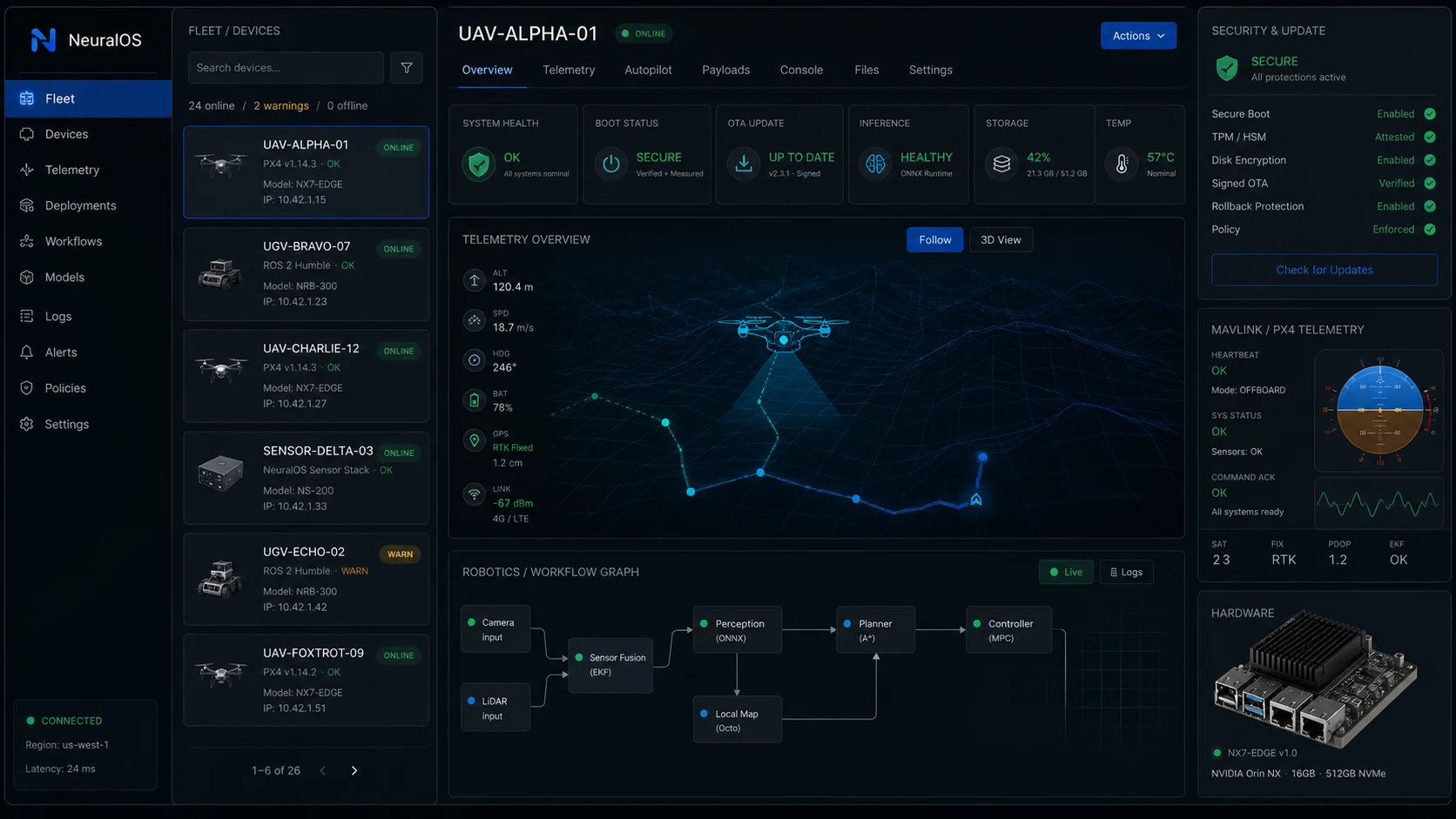
Vehicle compute and edge runtime. Model execution, preprocessing, local policy, health, logging, isolation inputs, and update agent run on defined target hardware.
Connectivity and fleet platform. Secure telemetry, diagnostics, update, vehicle identity, cohort, command authorization, cryptographic inventory, supplier evidence, and offline reconciliation connect vehicle and operator.
Operations and engineering workflows. NowFlow links incidents, service, campaign approval, fleet action, engineering review, customer systems, and evidence.
Simulation, validation, and lifecycle. Requirements, scenarios, models, cryptographic dependencies, test runs, target benchmarks, releases, incidents, supplier changes, and corrective actions remain traceable.
04Field evidence
Profiles avoid invented vehicle counts, power figures, latency, safety integrity, or automated-driving performance. Those become program acceptance criteria.
Decision · Does this build meet the defined scenario and requirement gates for the next test stage?
Decision · Is the runtime and update path suitable for broader vehicle integration?
Decision · Which vehicle or event needs action, and who owns it?
Decision · Which assumptions and behaviors are supported for the next controlled test?
Decision · Which trust boundary and dependency should enter the first standards-based PQC migration pilot?
Manage scenarios, sensor and label provenance, model comparison, edge-case review, target-device result, and requirement traceability.
Benchmark an approved perception or cabin model on target compute, monitor health and resource use, and exercise staged update and rollback.
Connect telematics, maintenance, route or depot events, incidents, work orders, and operator decisions with privacy and retention controls.
Exercise bounded perception, planning, operator supervision, fallback, and after-action review inside a defined low-speed or off-road ODD.
Trace one representative vehicle-to-backend trust path through provisioning, certificate lifecycle, secure boot, firmware signing, OTA authorization, supplier libraries, revocation, offline behavior, and recovery.
Automotive regulations and standards attach to a manufacturer, function, vehicle, market, and safety/cybersecurity process. They guide engineering here; they are not Neura Parse compliance badges. These are design inputs, not certification claims.
The vehicle sponsor defines item, hazard analysis, safety concept, integrity targets, verification, validation, confirmation, and production evidence.
Sponsor-ledAddress intended-function insufficiency, foreseeable misuse, triggering conditions, unknown scenarios, and validation where applicable.
Requirements referenceMap cybersecurity and software-update management obligations, evidence, monitoring, incident, and change for applicable markets and vehicle types.
Market-specificAnchor ML-KEM, ML-DSA, and SLH-DSA inventory, supplier evidence, interoperability testing, staged migration, and crypto-agility decisions across vehicle and backend lifecycles.
Migration referenceDefine lawful purpose, minimization, access, retention, sharing, security, driver/passenger rights, and incident response.
Deployment-specificNHTSA
Primary U.S. public context for automated-driving terminology, safety, development, and deployment considerations.
Open ↗R02UNECE
Primary regulatory context for vehicle cybersecurity management systems in adopting markets.
Open ↗R03UNECE
Primary regulatory context for software-update management systems and vehicle software updates.
Open ↗R04NIST
Cross-sector reference for mapping, measuring, managing, and governing AI risk across the lifecycle.
Open ↗R05NIST
Primary source for standardized ML-KEM, ML-DSA, and SLH-DSA plus migration guidance relevant to long-lived vehicle identity, signing, OTA, backend services, and supplier dependencies.
Open ↗05Deployment path
Choose one delivery route, then inspect the supporting analysis only when needed.
Mobility programme review
We can scope data and evaluation workflows, edge runtime benchmarking, fleet integration, update governance, and a bounded prototype without claiming production readiness in advance.